
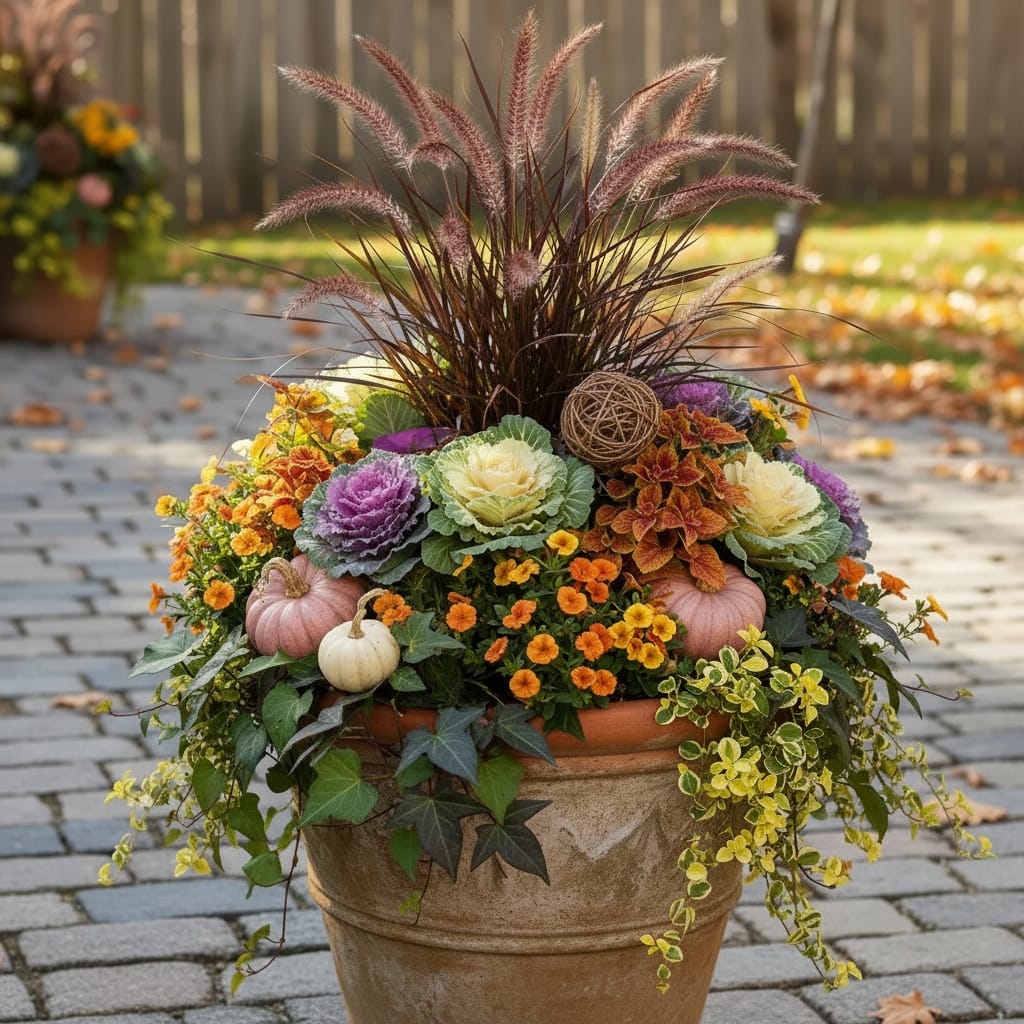
A Michigan porch runs on two clocks in the fall. The calendar says decorating season starts around Labor Day. The thermometer says the first frost is never far behind, and the first hard freeze follows it. A display built without that second clock looks expensive for three weeks and looks like a mistake for the three after that.
The good news is that the best fall plants are not the fragile ones. Several look better once the nights turn cold. Here is what holds, what fails, and how to scale the arrangement to the entry you actually have.
START WITH THE PLANTS THAT IMPROVE AFTER FROST
A few fall container plants treat a frosty night as ordinary weather. Build around these and everything else is an accent you can afford to lose.
- Ornamental kale and cabbage. The most reliable thing you can put in a Michigan fall porch pot. Cool weather deepens the purple, cream and rose in the center of the rosette, so frost improves the color rather than ruining it, and they hold their shape long after the flowers around them quit.
- Pansies and violas. The late shoulder plant. They keep blooming in weather that stops everything else, and they often stand back up after a freeze that laid them flat. If you want something still in bloom in November, this is it.
- Dusty miller. Silver, felted foliage that takes cold without complaint and reads clean against orange pumpkins.
- Heuchera, also sold as coral bells. A hardy perennial with foliage in amber, burgundy and lime. It holds color into late fall, and then goes into a garden bed instead of the compost pile.
MUMS ARE THE ANCHOR, WITH TWO CAVEATS
Garden mums earn their reputation: right size for a container, the whole fall color range, covered in buds. Nothing else delivers that much color for that little effort. Two things decide whether yours last.
Buy them in tight bud, not in full bloom. A mum at peak on the bench has spent most of its show. One still in bud opens on your porch and stretches the display by weeks.
Water them more than you think. Mums are thirsty, and a container in autumn wind dries out faster than the cool air suggests. A wilted mum recovers once or twice, then stops.
ASTERS, GRASSES AND THE TEXTURE LAYER
Color alone reads flat from the street. Texture and height are what make a pot look designed rather than assembled.
Asters bloom late in purple, lavender and pink, and pull in the last pollinators of the year. The flowers are frost sensitive, so treat them as an October plant.
Ornamental grasses are the height layer, and they have a useful quirk. Purple fountain grass and purple millet are tender, so the first hard freeze ends them, but their plumes keep their shape and much of their color for weeks afterward. A dead grass plume still looks intentional, which is not true of a dead flower. Switchgrass and northern sea oats are hardy and fade to tan.
Dried elements belong in the same layer. Corn stalks tied to a porch column, broom corn and wheat bundles add vertical mass no living plant gives you in October, and cold does nothing to them.
WHAT DIES FIRST IN A MICHIGAN COLD SNAP
This is the list worth knowing before you spend money. All of it is still for sale in September and looks healthy on the bench.
| Plant | What cold does to it |
|---|---|
| Croton | A tropical. Drops leaves once nights turn chilly and will not take a freeze. A September accent, not a November one. |
| Coleus, sweet potato vine, begonias, impatiens | Collapse at the first frost, usually overnight. |
| Mums and asters | Foliage holds through light frost. The open flowers are the vulnerable part. |
| Purple fountain grass, purple millet | Killed by a hard freeze, but the plumes keep their shape and color for weeks after. |
| Ornamental kale, cabbage, pansies, violas, dusty miller | Unbothered by frost. Kale colors get better. |
It is also why a display installed in early September can look worse in late October than one installed three weeks later.
PUMPKINS AND GOURDS, USED WELL
Pumpkins are the cheapest mass you can add to an entry, and mass is what makes a display read from the curb. Four habits separate a grouping from a pile.
- Group in odd numbers and vary the size. Three pumpkins in three sizes look composed. Two matching ones look like bookends.
- Mix beyond orange. White ghost pumpkins, warty green heirlooms and flat cheese pumpkins give a grouping depth that identical orange ones never get.
- Set them at the base, not in the pot. A pumpkin pressed into potting soil sits wet, rots sooner and takes up room the plants need. Cluster them on the step instead.
- Leave them uncarved, and off wet mulch. A carved pumpkin is on a short clock. An intact one kept out of standing water holds for weeks in cool weather.
- Plan for squirrels. Chewed pumpkins are a common way a Michigan fall display ends early. Ask about deterrent treatment before the damage starts, not after.
SCALE AND PLACEMENT FOR YOUR ENTRY
The most common mistake is not plant choice. It is size. A container that looks generous from the doormat can disappear from thirty feet away.
- Narrow stoop or small landing. One container, tall rather than wide. A matched pair only works if the storm door has room to swing. Add mass with pumpkins on the steps, not a second pot.
- Standard covered porch. A flanking pair at the door, with a pumpkin grouping on one side of the steps rather than both. The asymmetry keeps it from looking like a storefront.
- Wide or wraparound entry. Repetition holds a long porch together. Repeat one plant and one color across the full run, then add height with corn stalks or a hay bale.
- Commercial entry or storefront. Bigger elements, fewer of them, higher contrast. Fine detail is invisible from a parking lot.
A RECIPE THAT WORKS ON ALMOST ANY MICHIGAN PORCH
If you want one arrangement to copy, build it in this order.
- Set the height first: an ornamental grass in the center, or corn stalks behind the pot.
- Add two mums in tight bud, offset rather than centered.
- Tuck ornamental kale at the front rim, rosettes facing the walkway.
- Fill the gaps with pansies, which will still be blooming when the mums are done.
- Rest small gourds on the soil at the rim, and group pumpkins at the base.
Everything on that list except the mums shrugs off frost, so the pot changes character as the season turns rather than falling apart. Our guide to timing the swap covers when the same container should change over for winter.
COMMON QUESTIONS ABOUT FALL PORCH POTS
When should I put out fall porch pots in Michigan?
Early September is the practical start, once nights cool off and summer annuals look tired. If you want the display at its best for Halloween and the weeks after, installing nearer the end of September means less of it is tender material that has already peaked.
Will mums survive frost?
Mum foliage takes a light frost. The open blooms are the fragile part, and a hard freeze ends them. Pairing mums with ornamental kale and pansies is the fix: when the mums finish, the pot still has color and shape rather than a hole in the middle.
Do fall planters still need watering?
Yes. Cool air is misleading. Containers are exposed on every side and autumn wind pulls moisture out fast, so a pot in full sun can dry out in days. Check the top inch of soil weekly, and more often for mums. Our maintenance service handles this for clients who would rather not think about it.
What can I plant in fall that lasts until Christmas?
Ornamental kale and cabbage come closest among living plants, and pansies often run later than people expect. Past that point the answer stops being plants at all: once the ground freezes, cut evergreen boughs and branches are what hold. See winter porch pots in Michigan for what that looks like.
Can I reuse the same container all four seasons?
Usually yes. What matters is the material: fiberglass, resin, concrete and metal handle Michigan freeze-thaw cycles, while terracotta and glazed ceramic crack. A planter subscription works this way by design, replanting the same containers four times a year.