
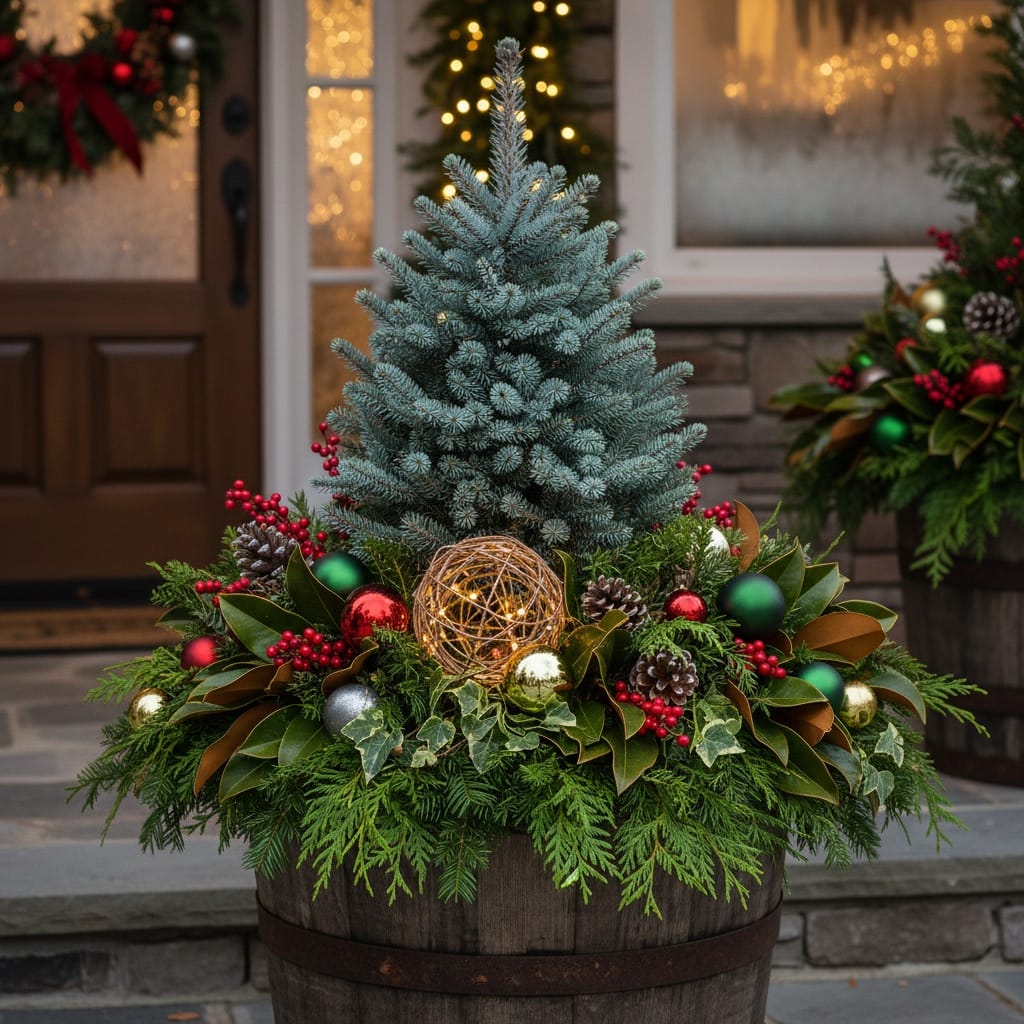
Search for the cost of a holiday decorating service and you will find national average figures. They are close to useless. They blend a single wreath on a townhouse door with a fully lit estate roofline, across markets with nothing in common, and they tell you nothing about your porch.
What is genuinely useful is knowing what the number is built out of. Every one of these services prices the same handful of inputs, and once you can see them you can tell which parts of a quote are fixed and which parts you can move.
COST IS BUILT FROM VOLUME, NOT FROM THE SIZE OF YOUR HOUSE
The most common wrong assumption is that a bigger home costs more. What actually costs more is a longer list of decorated features. Two containers at the front door is a small job on any house. Two containers, window boxes, a lit garland along the rail and a pair of urns at the drive is a large one on any house.
Material is bought and consumed by volume, and labor tracks the number of separate things a crew has to build and reach. Those two together drive most of the number.
THE EIGHT THINGS THAT MOVE THE PRICE
Any quote you receive is some combination of these. When a quote is higher than you expected, one of them is usually the reason.
- Number and size of containers. Size matters more than count. A large urn swallows several times the material of a small pot, so one big container can cost more to fill than three small ones.
- Material volume and mix. The real unit of cost. Greens are bought by volume, and specialty items priced individually: winterberry stems, magnolia, birch. A dense, layered arrangement uses considerably more material than a simple one in the same pot.
- Fresh-cut or artificial. Fresh material is a cost every season. Artificial is a larger first-season number that then carries forward, and it brings storage with it.
- Lighting. Whether lights are included at all, how many runs, battery or plug-in, and whether power already exists where you want it. Lighting at container level is straightforward. Anything requiring a ladder is a different job with different labor and different risk.
- Install labor and access. How long the crew is on site, and how hard the site is. Stairs, gates, long carries from the truck, tight entries and early snow all add time.
- Travel. Distance, and whether a crew is already routed through your area that day. This is why service areas exist, and why the edge of one costs more to reach than the middle.
- Take-down and disposal. Removal is real work. Someone has to pull the material, load it, haul it and dispose of it, or store it if it is reusable. Whether that is bundled into the price or quoted separately is one of the biggest differences between two quotes that look similar.
- One-time or recurring. A single install carries its own site visit, design time and setup trip. A recurring arrangement spreads those fixed pieces across several changeovers instead of loading them all onto one.
HOW TIERING WORKS: A REAL EXAMPLE
Most decorating services quote in tiers rather than by the hour, and the way the tiers step up shows exactly which drivers are in play. Our own published fall pumpkin packages are a concrete example, because the prices are public and the contents of each tier are listed.
| Tier | Price and what changes |
|---|---|
| Petite Porch | $295. Delivery only, 15 to 18 pumpkins plus minis and gourds. You arrange it yourself. |
| Classic Curb Appeal | $495. 25 to 30 pumpkins and a hay bale, and professional design and setup are now included. |
| Signature Harvest | $750. 40 to 45 pumpkins including specialty and heirloom varieties, 2 hay bales, 2 mums, corn stalks, full design consultation. |
| Grand Estate | $1,095. 60+ pumpkins, 3 hay bales, 4 mums, a layered tiered arrangement, and end-of-season removal is included. |
| Luxury Manor / Commercial | Starting at $1,650, quoted custom. 80+ pumpkins, multiple hay bale groupings, 6+ mums, a fully custom layout and a white-glove walkthrough. |
Three things in that ladder are worth noticing, because they generalize to almost any seasonal decorating quote.
The first step up is mostly labor, not material. Going from $295 to $495 adds roughly ten pumpkins and one hay bale. What really changes is that design and setup move from you to us. That gap is the price of the work, not the price of the goods.
Take-down is a line item, and it is visible. Removal is bundled into the top tiers and offered as a $150 to $200 add-on for the lower ones. That is a fair picture of what removal genuinely costs on any seasonal display, holiday work included.
The top tier is a starting price, not a price. Once a job is fully custom, nobody can responsibly name a final number before seeing the property. A quote that reads "starting at" is being honest about that.
THE LEVERS YOU ACTUALLY CONTROL
Some of the eight drivers are fixed by your property. Several are choices, and these are the ones worth discussing before a quote is written.
- Delivery only versus full service. If you enjoy arranging things, taking delivery of the material and building it yourself removes the design and install labor from the price. If you would rather it be finished when you get home, that labor is what you are buying.
- Fewer features, done well. Two generous containers at the front door read better from the street than six thin ones spread around the property, and cost less.
- Container level versus roofline. Keeping lighting at ground and container level avoids ladder work entirely, which is one of the larger swings in any lighting quote.
- Reusable material. Artificial garland and picks are a first-season cost that carries forward. The question to ask is who stores it and whether storage is included.
WHAT A QUOTE SHOULD TELL YOU BEFORE YOU SAY YES
Two quotes with the same number can describe very different amounts of work. These are the questions that separate them.
- Is design included, or is this delivery of material only?
- Is installation included, and is it a fixed price or a starting price?
- Is take-down included? If not, what does removal cost?
- Who owns any reusable material afterward, and who stores it?
- Is lighting included, and who handles batteries or a failed run mid-season?
- What happens if weather pushes the install date?
- Is anything about this quote dependent on a ladder?
A service that answers all seven without hesitating is quoting from experience. One that cannot is guessing, and a guess is where surprise charges come from.
COMMON QUESTIONS ABOUT HOLIDAY DECORATING COST
How much does a Christmas decorating service cost near me?
There is no honest single answer, because the eight drivers above vary so much between properties. What we can tell you is that we quote holiday work per property rather than from a list, after looking at the containers, the features you want decorated, the access and the lighting. A photo of your entry is usually enough to start the conversation.
Does a bigger house automatically cost more to decorate?
No. Cost follows the number and size of the features being decorated, not the square footage of the house. A large home with two containers at the front door is a smaller job than a modest one with containers, window boxes, garland and lighting.
Why is take-down sometimes charged separately?
Because it is a second visit with its own labor, travel and disposal. You can see the effect in our published fall packages, where removal is bundled into the top tiers and offered as a $150 to $200 add-on for the lower ones. Any seasonal display has the same structure, so it is always worth asking which side of the line removal falls on.
Is it cheaper to do it myself?
On material alone, usually a little, and plenty of people enjoy the work. The real comparison includes your time, the cost of buying the wrong material once, and whether a ladder is involved. Our winter porch pots guide is written to be followed by hand, so the do-it-yourself route is a genuine option and we would rather you did it well.
Is one-time or recurring service the better structure?
It depends on how many seasons you want covered. A one-time install carries its own site visit, design and setup trip. A planter subscription spreads those fixed pieces across four changeovers a year and keeps the containers and palette consistent between seasons. Neither is automatically the right answer, but they are shaped differently and it is worth choosing deliberately.